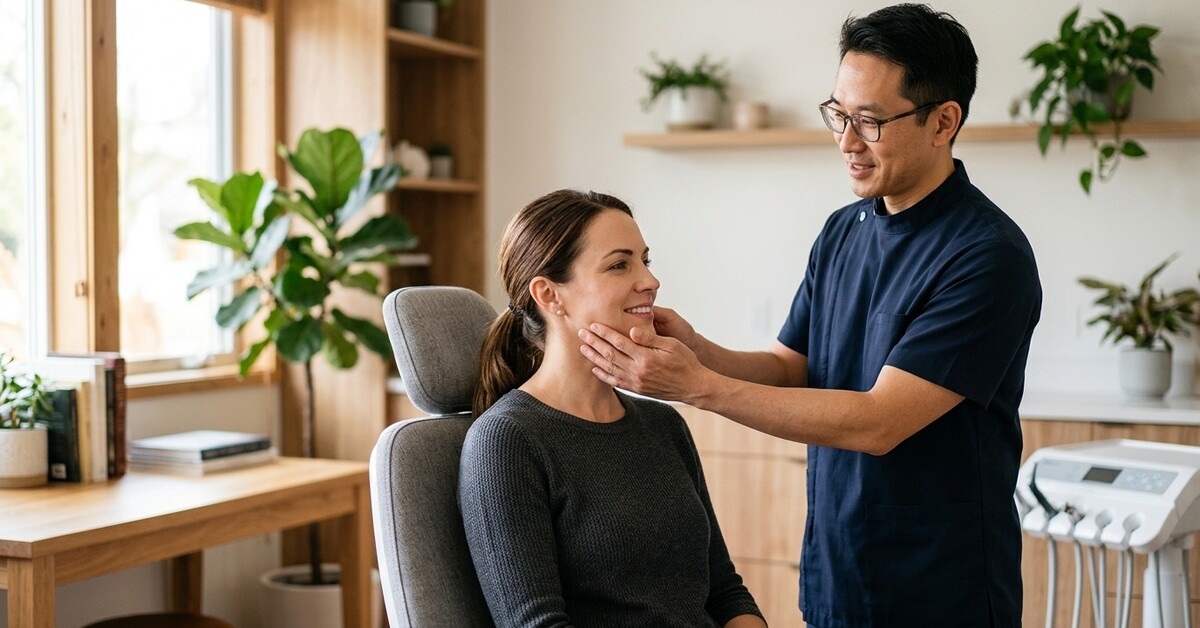
A neuromuscular dentist looks at more than teeth: the jaw muscles and joints that have to work with your bite every time you chew, speak, or swallow. When teeth, muscles, and joints line up, the whole system works without you noticing it. When they fight each other, the strain can surface as jaw pain, tension headaches, or teeth that wear down faster than they should.
What Is Neuromuscular Dentistry?
Most dental care focuses on two things: teeth and gums. Neuromuscular dentistry adds a third, the muscles and joints that move and position your lower jaw. Your bite is part of a system of teeth, muscles, and joints, and a neuromuscular dentist evaluates whether that system is working together or working against itself.
Here is why that matters. If the teeth do not fit together properly, the muscles and joints accommodate, working overtime to force a fit. Muscles that stay at work when they should be at rest become sore, and that constant overwork can pull the jaw joint out of comfortable alignment. The pain often shows up far from the teeth, in the temples, face, or neck.
Is neuromuscular dentistry the same as TMJ treatment? Not quite: TMJ treatment addresses the jaw joint and its symptoms, while the neuromuscular approach examines the bite alignment underneath, and the two often work together. Our guide to TMJ and facial pain treatment covers the joint side in depth.
What Does Neuromuscular Dentistry Treat, and Does It Work?
Patients usually search for neuromuscular dentistry near me because something keeps coming back. Common reasons for an evaluation include jaw pain or fatigue, clicking or popping when opening, frequent tension headaches, worn or chipped teeth without an obvious cause, and teeth that have shifted after earlier orthodontic work.
None of those symptoms proves the bite is the culprit. Each one has several possible causes, which is why a careful evaluation matters more than any label. A good neuromuscular dentist rules causes in or out rather than promising a cure.
Does neuromuscular dentistry work? You may see debate about it online, and healthy skepticism is fair. It is an approach to diagnosis and treatment planning, not a miracle procedure. What it offers is a wider set of measurements: how the jaw moves, where the muscles hold tension, and how the teeth meet. Conservative steps such as bite appliances come first, and invasive procedures are a last resort.
How Do I Know If My Bite Is Misaligned?
Some signs you can spot at home. Close your teeth gently and notice whether they meet evenly or one side touches first. Watch for chewing that favors one side, a jaw that feels tired by evening, flattened edges on the front teeth, or waking with a sore jaw or a dull morning headache.
In the office, the evaluation gets more precise. The dentist studies how your teeth come together, checks the jaw muscles for tension, and uses digital radiographs to see the supporting structures. The airway matters too: restricted nasal breathing from allergies, a deviated septum, or enlarged tonsils can push a person into mouth breathing, which lets the tongue press the front teeth outward over time.
This is where neuromuscular orthodontics differs from conventional orthodontics. Conventional treatment focuses on straightening the teeth; neuromuscular orthodontics also studies the jaw muscles and upper airway to address what pushed the teeth out of line, aiming for a balanced bite with less risk of relapse. For some patients that plan includes clear aligner treatment such as Invisalign.
Your Denville Dental Team for Neuromuscular Dentistry
Neuromuscular Orthodontics and TMJ and Facial Pain Treatment are both dedicated services at Aesthetic Family Dentistry in Denville, NJ. Dr. Fine, Dr. Kwiatkowski, and Dr. Steiner care for patients from Denville, Rockaway, Parsippany, Mountain Lakes, and across Morris County, and you can read the practice’s full approach on our neuromuscular orthodontics service page.
The whole-system view is a natural fit here. As a holistic, biological practice, we look at how your mouth affects the rest of your health: mercury-free care, SMART-certified safe amalgam removal, and treatment planning that considers your muscles, joints, and airway alongside your teeth. Virtual consultations are available if you would like to talk through your symptoms before visiting.
If jaw pain, headaches, or worn teeth keep returning, an evaluation is a low-pressure place to start; it tells you what is actually happening, and treatment is always your decision. Call 973-627-3617 or visit aestheticfamilydentistry.com to request your appointment.